

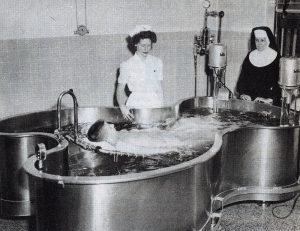
In July of 1949, Cape Girardeau County reported its first cases of poliomyelitis – commonly known as polio – marking the beginning of a significant regional outbreak. By the end of that month, over 100 cases had been identified locally. As the outbreak progressed, more than 200 cases were documented in the county before the close of the year.
At the time, major referral centers in St. Louis and Memphis were operating at or near capacity and unable to accommodate additional patients from smaller communities. This placed the responsibility of care on local institutions. In response, Saint Francis Hospital in Cape Girardeau became the primary facility in the region to admit and treat polio patients.
Despite its limited size and staff – comprised of 22 Franciscan Sisters and 104 lay employees, only six of whom were men – Saint Francis expanded its services to meet the community’s needs. A dedicated polio wing was established and grew to accommodate dozens of patients. The hospital acquired eight iron lungs, specialized negative-pressure machines that mechanically assisted breathing for individuals experiencing respiratory paralysis due to the disease.
To reduce the risk of transmission during the height of the outbreak, several public health measures were implemented. Public swimming pools, movie theaters, and other recreational spaces were temporarily closed. These decisions were guided by prevailing epidemiological understanding of polio’s seasonal spread and common routes of transmission.
One notable event during this period illustrates the coordination and resourcefulness of local healthcare teams. In November 1949, nurses Jane Kolbay and Adah Morse assisted in the transfer of a toddler reliant on an iron lung to a hospital in St. Louis. Due to the size of the equipment, a dairy truck was repurposed for transport. Ten men assisted in safely loading the child and machine, while a 200-foot extension cord ensured continuous power during the trip. When both onboard generators temporarily failed, the nurses manually operated the bellows of the iron lung until power could be restored by two Navy technicians accompanying the journey. Reports indicated the patient remained calm, even napping and interacting with the nurses during the transport.
Advances in medical research soon offered a path to prevention. In 1953, Dr. Jonas Salk introduced an inactivated polio vaccine. Following successful trials, the vaccine became publicly available, and the first doses were administered in Cape Girardeau on April 15, 1955.
The polio wing at Saint Francis Hospital remained active until 1962. Over its 13 years of service, it provided care to more than 649 patients, with 29 recorded deaths. The hospital’s sustained commitment to polio treatment represents a significant chapter in local medical history and reflects the broader efforts of healthcare providers across the country during a defining public health challenge of the mid-20th century.
Sources
- “Nurses Used Hand Pump to Save Toddler in Iron Lung”, St. Louis Post-Dispatch
- “1949 Polio Epidemic”, Southeast Missourian, January 11, 1998
